RMB
  • About
  • Solutions
  • Insights
  • Careers
  • Contact
  • Logins
  • flag
More about RMB
SolutionsDealsCareersContactDocumentsLoginsCitizenshipNews AwardsCultureSponsorships and EventsDiversity Equity and Inclusion
Branded Companies
  • RMB Corvest
  • RMB Private Bank
  • RMB Ventures
Banking Network
  • RMB South Africa
  • RMB Botswana
  • RMB Namibia
  • FNB CIB
  • RMB Nigeria
  • RMB Nigeria Asset Management
  • RMB UK
  • RMB India
  • RMB USA
  • RMB USA Securities
  • Rand Merchant Advisory
FNB CIB Branded Subsidiaries
  • First National Bank Ghana
  • FNB Lesotho
  • FNB Mozambique
  • FNB Eswatini
  • FNB Zambia
Follow RMB on LinkedInFollow RMB on InstagramFollow RMB on FacebookFollow RMB on XFollow RMB on YouTubeFollow RMB on Tiktok
Terms and conditions
Regulatory disclosure
Termination Clause
PAIA guide
Privacy Notice
Cookie Notice
Customer complaints
Security awareness
FATCA
CRS
BEE
Tools
Supplier and Business Partner Privacy Notice
BASA Privacy Code of Conduct
Corporation for Deposit Insurance (CoDI)
Ethics Reporting Line
Pre-arranged visits

RMB – a division of FirstRand Bank Limited, is an Authorised Financial Services and Credit Provider NCRCP20.

Copyright © RMB 2026. All rights reserved.

  • Insights
  • Newsroom
  • News
  • Business confidence and activity weaken further in the third quarter

Businessconfidenceandactivityweakenfurtherinthethirdquarter


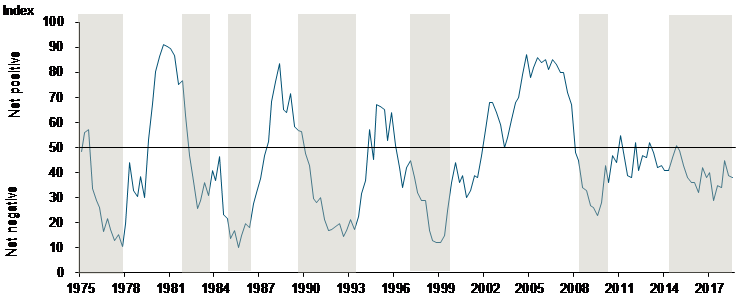
Following a new president inspired jump in the RMB/BER Business Confidence Index (BCI) to 45 in the first quarter, sentiment fell back to 39 in the second quarter and 38 in the third quarter. Although confidence rose marginally in two of the five sectors covered in the survey, not a single sector in the third quarter had a number above the neutral level of 50 – an infrequent and worrying development.

Figure 1: RMB/BER Business Confidence

Source: BER, SARB (Shaded areas represent economic downswings)

The third quarter survey was conducted during the month ending September 6, a period characterised by renewed disillusionment about the broad policy direction the country is taking. Further dampening the mood were fears of an acceleration in inflation and possibly higher interest rates to boot, as a Turkish-driven sell-off in emerging markets saw the rand weakening sharply to more than R15 against the US dollar. The survey covered 1 700 business people in the five sectors making up the RMB/BER BCI, namely manufacturing, wholesale, retail, new vehicle trade and building and construction.

Details

  • Manufacturers’ confidence dropped from 27 to 21 as activity continued to contract. A further significant weakening of domestic sales volumes on top of relatively poor export sales volumes dampened production.
  • After advancing by nine points to 62 in the second quarter, wholesalers’ confidence retreated by 13 points to 49. The sales performance mirrors this ebb and flow in sentiment. Of all the sectors surveyed, wholesale trade is still the one with the highest confidence level – albeit now also in net negative terrain.
  • Retailers’ confidence remained low at 33. Although sales volumes recovered somewhat, growth in turnover failed to improve as selling prices hardly budged, a sharp rand related increase in purchasing prices notwithstanding. Narrow and/or narrowing pricing margins continue to severely hurt retailers’ financial performance.

Motor trade and building contractors were the only two sectors which saw confidence increase in the third quarter.

  • As for new vehicle dealers, sentiment improved from 35 to a still disappointingly low 41, as sales volumes remained under pressure.
  • While building contractors’ confidence rose from 37 to 45, the improvement isn’t representative of the total building industry. Indeed, confidence among sub-contractors dropped noticeably in the third quarter. What’s more, the increase in building contractors’ confidence was solely due to residential contractors. They expect the fourth quarter to repeat its usual seasonal improvement in activity. By contrast, non-residential building confidence (and activity) fell back sharply in the third quarter.

Bottom line

Given the historically tight relationship between the RMB/BER BCI and real GDP growth, the renewed downward trend in confidence is disconcerting. On past form, it points to economic growth weakening even further after already slowing from 1.4% year-on-year in the first quarter to 0.5% in the second quarter. “The underlying South African business landscape continues to weaken, with more sectors showing signs of strain. While confidence hasn’t (yet) fallen to the levels observed during the previous (and severe) recession of 2009, we remain deeply concerned about the prospects” said Ettienne Le Roux, chief economist at RMB.

It goes without saying, the political and policy factors weighing down on business confidence (such as the government’s land reform plans) must be resolved to produce impetus for an increase in sentiment. This is especially the case now that global headwinds are mounting, domestic public finances are stretched and monetary policy is facing rising inflation risks.

loading form...

Related

Featured